By Merari Taboada
Unfortunately, the Coronavirus (COVID-19) has made its way through all parts of the globe, becoming a pandemic as declared by the World Health Organization (WHO). This statement has created waves of panic across the world and the urge to know more about this virus has led to much misinformation about the COVID-19 and influenza, also known as the flu.
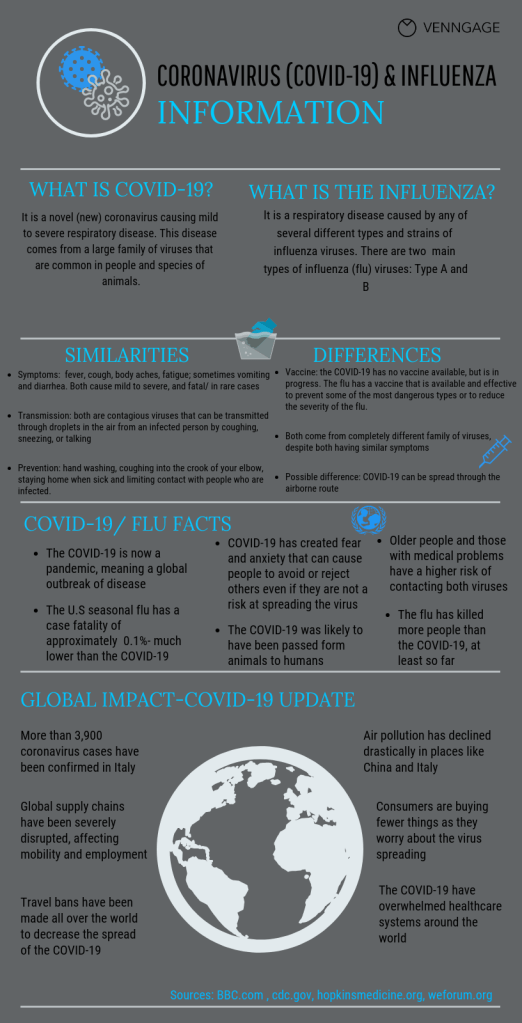
Many have begun to associate with having the flu as overall having the COVID-19, which is not entirely true as reported by Johns Hopkins Medicine. Although the COVID-19 and influenza obtain similar, if not the same, symptoms, there are some underlying facts that demonstrate a difference between both of them.
For starters, both the flu and COVID-19 come from two completely different families of viruses, meaning that one shouldn’t entirely associate one with the other, according to professor Jonathan Runstadler from the Department of Infectious Diseases and Global Health at Cummings School. Additionally, it is important to know that the flu has higher cases of fatality each year among older people and those with medical problems, even though the COVID-19 may likely be more contagious and surpass higher cases than the flu.
Furthermore, there is a vaccine for the flu, unlike the COVID-19. Despite, there being news on there being suppose “miracle medications” that can completely cure or prevent someone from getting the COVID-19, this type of news was declared false by Johns Hopkins Medicine and many universities such as Harvard Medical school. There is no vaccine or medication yet created for the COVID-19, although a vaccine is in process.
Overall one should know the differences between both viruses in order to be reasonably and rightfully informed. This will help one to debunk any myths, misconceptions, or conspiracy theories. The right information should be spread and there are many reliable sources, such as the CDC, WHO, and more, that can help inform everyone of the correct facts and statistics in regards to the difference of both viruses and how to prevent them.
 Merari Data Journalism